AVID & General Elective Courses
AVID & General Elective Pathways
A text-only version of the following pathway graphic is included below.
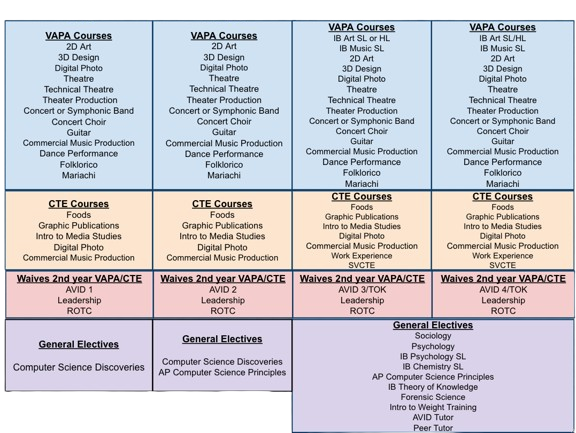
TEXT-ACCESSIBLE VERSION: AVID & General Elective Pathways (Click to VIew)
Del Mar offers the following AVID & General Elective Courses *
AVID's mission is to close the achievement gap by preparing all students for college readiness and success in a global society. The AVID program serves students in the academic middle who are often the first in their family to attend college. At Del Mar, AVID teaches students time management, note taking, organization and study skills. As AVID students progress through high school, they are supported in all aspects of the college application process.
AVID 9: Freshmen AVID students focus on a successful transition to high school. The emphasis for the 9th grade year is on earning a high GPA, developing strong study habits, getting involved in extra curricular activities, and staying organized.
AVID 10: Sophomore AVID students continue to focus on developing the same skills as those in AVID 9. AVID Sophomores spend a significant portion of their sophomore year participating in the Road Trip Nation curriculum. Road Trip Nation helps students identify possible career interests and culminates in an interview of a community member who currently works in a career of interest for each student. Sophomores also study for the PSAT and take a field trip to at least one university.
AVID 11/TOK +: Students in AVID 11/TOK are dual enrolled in the AVID and IB Theory of Knowledge course. The Theory of Knowledge portion of the course explores the question: How do we know what we know? This course focuses on college level writing and presenting skills. The AVID portion of the course focuses on supporting students in researching best fit colleges. By the end of Junior year students have developed their college apply list and written a rough draft of their college essays. Students also register and study for the SAT and ACT, which they will take in the spring of their Junior year. All eligible AVID Juniors also attend an overnight college field trip in the spring and visit four universities.
AVID 12/TOK +: Students in AVID 12/TOK continue with the second year of the IB Theory of Knowledge course. Students complete their TOK essay and presentation which is the final assessment for this course. The AVID portion of the course guides students through the entire college application process including: completing college applications, applying for scholarships and financial aid, and continuing to study for the SAT and ACT which students will take in the fall of their Senior year. Students also prepare for college level work and a successful transition to college life. Eligible AVID Seniors also have the opportunity to attend an overnight college field trip in early fall to visit four more universities.
+ UC/CSU Honors (Weighted)
This course requires the student to be a role model, academic tutor, and life coach to multiple grades and classes. Students will receive instruction in:
- Professionalism.
- Training and coaching including feedback on tutors, binders, etc.
- Students will be expected to facilitate large sustained group discussion, one-on-one coaching, checking points of confusion, note taking, and anchor grading.
- Tutors will be expected to participate in 16 hours of training and multiple follow up meetings..
This course is designed to equip students with core tools for interactive development in a challenging technological environment. Communication skills, basic mathematical concepts and critical thinking are reinforced through software applications. Multidisciplinary projects involve the use of a variety of programs such as word processing, spreadsheets, databases, image editing and graphic design, digital sound and video editing, web design and presentation software. Topics covered include history, hardware, computers and society, safe internet access, copyright issues and computer ethics. Hands-on projects focus on essential skills and provide experience in working in a broad range of media. Simulations, projects, portfolios and teamwork provide opportunities for application of instructional competencies.
Prerequisite: None
Computer Science Principles offers a multidisciplinary approach to teaching the underlying principles of computation. The course will introduce students to the creative aspects of programming, abstractions, algorithms, large data sets, the internet, cybersecurity concerns, and computing impacts. AP Computer Science Principles also gives students the opportunity to use
current technologies to create computational artifacts for both self-expression and problem solving. Together, these aspects of the course make up a rigorous and rich curriculum that aims to broaden participation in computer science.
Prerequisite: None
+ UC/CSU Honors (Weighted)
The leadership class is designed to facilitate the Student Government program (ASB). The class is intended to provide time for Associated Student Body (ASB) members to accomplish their goals and duties as representatives of the student body. Students develop their leadership skills in long and short term goal setting, time management/ organization, communication, leadership, school and community service, interpersonal relations, problem solving, team building, and evaluation and reflection.
This course will provide an opportunity for advanced students to work as peer tutors in a variety of courses where extra assistance may be needed for individual or group of students. Peer Tutors will learn leadership and teaching skills and be able to provide academic assistance to peers. Peer Tutors will be encouraged to think critically and offer constructive feedback to the teacher and peers.
Required: Recommendation by teacher and/or administration.
This course is designed to give students the opportunity to learn weight training concepts and techniques used for improving physical fitness. Students will learn the basic fundamentals of weight training, program development, program implementation and overall fitness training. Students will be empowered to make wise choices, meet challenges, and develop positive behaviors in fitness, wellness, and movement activity for a lifetime.
Psychology is the study of behavior and the examples of areas to be studied include learning and intelligence, problem solving, emotions, motivation, perception, sensation, personality development, and the ethics and methods of research. Students will develop skills in psychological research and methods. Career choices in the field of psychology will also be examined.
This is a one-year course that asks the fundamental questions of “Why do people behave the way that they do in certain situations?” and “How can people change their behaviors?” The course emphasizes historically significant research and research methodology. Students are expected to develop their critical thinking and research skills throughout the course. Each student will be required to complete an “Internal Assessment.” The Internal Assessment includes researching background information, planning, and conducting a research experiment. UC/CSU Weighted.
Part 1: Levels of Analysis—Biological, Cognitive, Socio-cultural. Students focus on understanding the biological, cognitive and socio-cultural influences on human behavior and explore alternative explanations of behavior.
Part 2: Option (but not optional)—Developmental Psychology: To what extent do Biological, Cognitive, and Socio-cultural factors influence development? Evaluate psychological research relevant to developmental psychology.
Part 3: Research Methodology—Methodology is a significant part of the course. The internal assessment is based on these topics: Introduction to research methods, ethics, and quantitative research methods. Research methodology will be ingrained and significant to each of the segments of IB Psychology, with a focus on ethics and ethical treatment of research participants.
Part 4: Simple experimental study—knowledge of research methods will be applied in the study and ethics and the use of quantitative research methods are required elements. Students will design and replicate a significant psychology research experiment.
+ UC/CSU Honors (Weighted)
This course is the systematic and scientific study of human behavior, social groups, and society. Students will examine the personal and institutional forces that shape everyday life, behavior, and social values. Students will develop a sense of social behaviors that exist or have existed in the world and demonstrate their understanding through interviews, simulations, role playing and analysis of current events. Career choices in the field of Sociology will also be examined.
The student assistant program offers a variety of work-based activities to reliable and mature students. The student may serve in the following positions: classroom aide, laboratory assistant, library and office clerk. The course is 2.5 units, and students are given a pass/fail grade only.
TOK is a two-year course about critical thinking and inquiring into the process of knowing, rather than about learning a specific body of knowledge. The TOK course examines how we know what we claim to know. It does this by encouraging students to analyze knowledge claims and explore knowledge questions. There are two assessment tasks in the TOK course: an essay and a presentation. The essay is externally assessed by the IB, and must be on any one of the six prescribed titles by the IB for each examination session. The presentation, done individually or in a group, is internally assessed by the teacher.
+ UC/CSU Honors (Weighted) - Year 1 & 2
Note: Priority registration will be given to IB Diploma Programme Candidates.
* For more specific course details, please refer to the 2025-26 CUHSD Course Catalog. Should you require additional information, please speak with your teacher or your School Counselor.